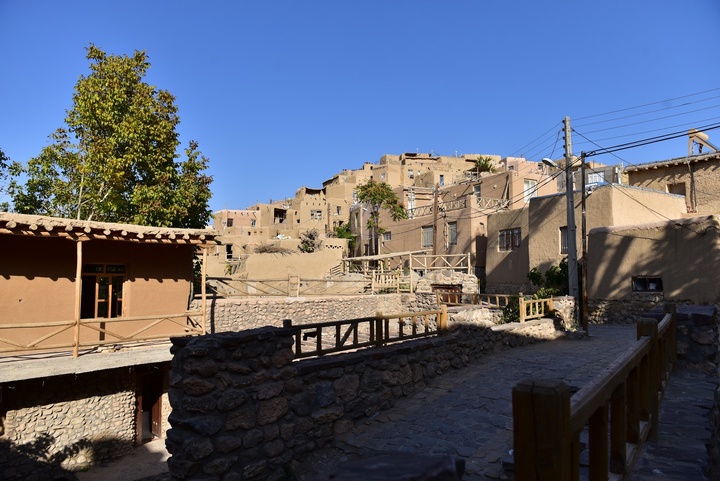
The Role of Tourist Villages in Rural Employment Development/1
Rural tourism can make a significant and effective contribution to the economic and social development of our country, given its vastness, special geographical location, and the various historical and natural attractions of each village. ... Garmsar, Rikan village, Garmsar, Forumad village, Miyami, Qaleh-Now Kharqan village, Shahroud, Zamanabad village, Miyami, Qaleh Bala village ...
Miras Aria: The climatic diversity prevailing over the villages of Semnan has led to the formation of magnificent ecosystems and landscapes, and has established a wide range of plant and animal communities, such that the villages located in the northern regions are green lands that have been covered by dense forests since ancient times, and these areas lead to the Alborz mountains and mountain ranges. In the south of these mountain ranges, dry and desert lands and dry rivers and mountains are seen, which are rarely covered by plants.
These completely different climatic landscapes have nurtured a diverse range of plant and animal habitats, which distinguishes Semnan province from many neighboring provinces. This climatic diversity and animal and plant biodiversity, if appropriate measures are taken, can attract recreational and scientific trips to the province. However, despite these immense capabilities, many of these attractions remain unknown to domestic and foreign tourists, and they are not optimally utilized. Therefore, the problem of underdevelopment in rural communities still remains the main issue. It is necessary to examine the existing and potential facilities of rural tourism attractions in the country and provide solutions for their optimal utilization.
Rural tourism development has been introduced as one of the most important sources of income and a major component in improving the economy of rural areas. In such a way that the income from this industry has grown faster than the income from the production, sale, and export of various goods and services in many countries. The rural tourism industry leads to the expansion of various services, the creation of job opportunities, and the development of infrastructure in all parts of the villages, which ultimately leads to human development.
Green tourism, sustainable tourism, and biotourism are various terms used for nature tourism or ecotourism. Desert trekking, hydrotherapy, caving, mountaineering, hunting, fishing, sand skiing, rural tourism, water sports, and viewing natural landscapes such as waterfalls and rivers are among the components of ecotourism.
In recent years, in developed countries, due to industrialization, rural tourism development, considering natural and climatic attractions, has been introduced as a source of income in global trade and a major component in improving the economy of rural areas and countries. The increase in population growth in recent decades has had profound effects on the economic and social structure of countries, and meanwhile, the increase in population needs has changed in quantity and quality over time and with the evolution of human life.
In rural communities, meeting these needs, considering the type of livelihood on which the village economy is based, is mainly done through the exploitation of nature and natural resources. Over time, the exploitation of these resources has increased, and in the long term, with the limitation of these resources, the economy and development in rural communities will face serious challenges.
Rural tourism development (ecotourism) can bring countless economic benefits directly to the villagers by creating job opportunities. In this regard, facilities are created for economic use for individuals in professions related to this industry and for natural landscapes, and consequently, the necessary funding is provided for their preservation. Rural tourism is often characterized by an environmental orientation and the enjoyment of natural resources, and it can be effective in purifying and protecting the environment and spreading environmental culture among people.
Ecotourism is a branch of tourism that requires the participation of local communities, and the best and most capable tour guides for nature tours are none other than the local people living in the areas, who can easily guide tourists. This issue plays a fundamental role in reducing the excessive migration of villagers to cities and their employment, and many accommodation centers and handicraft production centers and products, etc., in the most remote parts of the country join the economy and lead to job creation and improvement of the living standards of rural people.
In Semnan province, 40 villages have been selected as tourist villages. Climatic diversity, historical, natural and cultural attractions, housing, environmental components, and geographical distribution, etc., are among the factors that have been effective in selecting these villages. These villages include:
More than 23% of the area of Semnan province consists of protected areas and wildlife refuges, which is about 25% of all protected areas in Iran. According to the plans made, Semnan province has eight ecosystems named Khwar and Turan, Pol-e-Abresham, Qasr-e-Haj-Aliqoli, Biarjomand, North Shahmirzad, Qasr-e-Semnan, Garmsar, and Ivanki.
The people of the villages of Semnan province, due to their cultural and physical interaction with neighboring provinces, especially Khorasan province on one hand, and Tehran province and the northern provinces on the other hand, have special conditions. The customs and rituals prevalent in the villages of the province are influenced by cultural and religious communications and interactions.
The lifestyle of the people in the villages of Semnan province is influenced by their livelihood pattern in two forms: rural settlement and nomadism.
Regarding the architectural style of the selected villages, a traditional and indigenous pattern can be observed in the villages. The traditional and indigenous pattern is influenced by the climatic and living conditions of the region and has been observed in historical works and buildings and has major features such as:
Simplicity in housing construction
Use of local and efficient materials
Use of religious and social symbols
Adherence to cultural and social principles and conditions
Allocation of special spaces for reception, sleeping, and summer and winter seating, along with a warming room, kitchen, water reservoir (pashir), pool house, pantry, double layer (place for storing food), baleh (covered corridor and hallway), cupboard, shelf, wall heater, etc., are examples that have had special uses in the selected villages, which can be referred to as village museums, such as Reshm village in Damghan desert.
The prevalent customs and traditions in these selected villages can be used to expand tourism in this sector, such as ceremonies like choosing a spouse, engagement and wedding, mourning and sorrow, etc.
Ta'zieh is one of the religious ceremonies that, due to its history, the use of local dialect in expressing sentences, and the use of visual symbols, and the existence of women's Ta'zieh ceremonies, which are rare in other parts of the country, is one of the ceremonies that can be effective in attracting tourists on special occasions. Baking various traditional breads and pastries in the village is effective in attracting tourists and creating employment.
Local games are among the important potentials of these villages, which exist in different age groups and among men and women in rural communities. They are important cultural elements that are considered one of the factors in socializing individuals in sociological studies. Certainly, climatic and social conditions, etc., affect the appearance and method of execution of these games and their purposefulness, which is very suitable for attracting tourists and creating employment with proper supervision and planning.
The local languages of Semnan province and those prevalent in the villages, due to the pristine nature of these areas, are the best means of communication between individuals and groups and form the basis of literature and culture. Different languages create new motivations for establishing more communication. Alongside each language, dialects and accents have formed, which when we think about them or are immersed in them, we feel a sense of joy from all this diversity.
The language of the people in the eastern villages of the province, such as Forumed, is more connected to the language of the people of Khorasan, and the language of the people in the western part of the province is close to the language of Ray. The language of the people in the northern regions, such as Chashm, Maladeh, and Kalateh Rudbar, is related to Gilaki and Mazandarani, and in some areas, such as Nardin, it is related to Turkic. The people of the central regions of Semnan and its surrounding cities and villages have specific dialects that, not only in pronunciation but also in derivation and etymology, have no similarity with the dialects of their neighbors and are among the authentic dialects of Iran.
Regarding the attraction of language and dialect in tourism, it should be said that different languages can be attractive to some and provide motivation for research, study, and learning that language, which can pave the way for travel.
Out of the selected villages, about 50% are located in protected areas, which is one of the important potentials for employment and attracting tourists, and with precise planning, appropriate utilization can be achieved.
Many of these villages have nomadic communities, and considering the special living conditions of nomadic communities, a macro-level study of their situation regarding tourism is of particular importance. Nomads, with characteristics such as tribal structure, territory, seasonal migration, employment, special customs and culture, as well as a specific livelihood, can be important in attracting tourists, especially social tourists.
In parts of the selected villages of the province, nomadic communities reside. In terms of nomadic territory, the concentration of nomads during the wintering period is in the areas of Khwar and Turan, Pol-e-Abresham, Biarjomand, Taroud, Qasr-e-Haj-Aliqoli, Sar-Qasr-e-Semnan, Garmsar, and Ivanki, and during the summering period, it covers the mountainous strip of the north of the province and large parts of the summer pastures of Tehran and Mazandaran provinces.
One of the major characteristics of nomads that can be used as a general indicator for tourism expansion is their dwellings. Considering the changes that occur throughout the year in the field of life and livelihood, the summer and winter dwellings are of particular importance in the functional separation of living spaces based on the front area for men's work, the middle area for women's work, the front area for storing sacks and skins, etc. In addition to the above, the place for keeping livestock is also a separate example of the functional creativity of nomads.
The time difference between wintering and summering is four months, and the remaining four months are spent by the flocks in the summer pastures of دماوند (Damavand). In spring and summer, nomadic shepherds migrate to the summer pastures with their livestock. The families of the shepherds accompany the shepherds during spring and summer and stay in the cold regions while living in the warm regions. The customs related to nomads and their lives, which are common in the villages, are among the factors that attract tourists.
Maryam Soleimaniyan, Advisor to the Director General of Cultural Heritage, Tourism and Handicrafts of Semnan Province