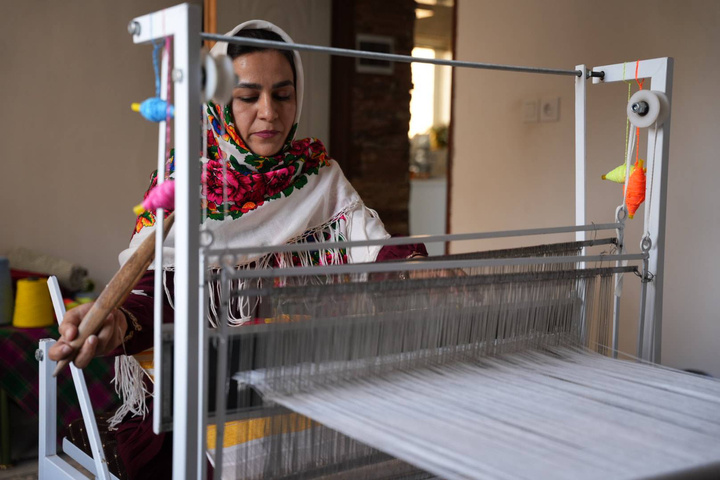
Tané-bafi in Qaleh Bala Village, From Tradition to Innovation and Economic Prosperity
Tané-bafi, an authentic and laborious art, has woven the warp and weft of the lives of the women of Qaleh Bala village from ancient times to the present. This art, rooted in the rich traditions of this land, continues to narrate the story from the past to today with the artistic hands of the village women... Miarith Aria _ Not so long ago, when the clamor of the digital age had not yet reached Qaleh Bala village, the women of this land... resulted in the creation of simple yet authentic towels, tablecloths, and handwoven items. Among the artistic women of Qaleh Bala, the name Haji Zahra shines like a bright star. A wise and hardworking old woman who has tied the years of her life...
Miarith Aria _ Not so long ago, when the clamor of the digital age had not yet reached Qaleh Bala village, the women of this land, with artistic hands and hearts full of patience, preserved the art of Tané-bafi like a precious jewel in their adobe homes. Wooden and traditional workshops occupied a corner of the room or the porch of the houses; a place where sunlight shone through the small windows, reflecting on the white and colored threads. In that space, the rhythmic sound of the combs beating and the shuttle passing through the warp created a pleasant melody; a melody that accompanied the rhythm of the women's daily lives in the village.
The old Tané-bafi loom, with a wooden, simple, yet efficient structure, came to life. Warping the fine threads was the first step, carried out with precision and patience. The warp threads were arranged side by side with exemplary order and rested on the wooden beams of the loom. A pit was dug under the weaver's feet so that the feet could freely move the wooden pedals. With each foot press, the combs moved up and down, opening the way for the shuttle to pass. The shuttle, carrying colorful spools of thread, passed through the warp threads, weaving the weft and warp together. This coordinated movement of hands and feet, mind and heart, was a combination of skill and love that ultimately resulted in the creation of simple yet authentic towels, tablecloths, and handwoven items.
Among the artistic women of Qaleh Bala, the name Haji Zahra shines like a bright star. A wise and hardworking old woman who has tied the years of her life to Tané-bafi. Her hands are now trembling, but they still move steadily and confidently on the wooden loom. The wrinkles on her face seem like patterns of years of experience and memories; memories of days when houses were filled with the sound of looms and young girls learned the art from their mothers. Haji Zahra's wooden loom is today the only surviving example of the old generation in the village; a loom that is not just a tool, but a legacy of a generation of hardworking women. Every time she moves the shuttle through the warp, she seems to bring the past to life and showcase the glory of bygone years again.
For the old generation, Tané-bafi was not just a profession; it was a part of life. Girls sat with their mothers from childhood, listened to the rhythmic sound of the loom, and gradually learned the secrets of the craft. Weaving taught patience; it taught order; and most importantly, it brought the feeling of creation to life within a person. Every towel that was woven was the result of hours of effort and concentration. The colors were often limited but harmonious; white, crimson, blue, and green. Simplicity prevailed in the designs, but this very simplicity was a sign of the authenticity and sincerity of the art.
But time is always in motion, and art, to survive, is inevitably bound to transform. With the passage of years and the changing needs of the market, the new generation of village women looked at this ancient art with a fresh perspective. In this regard, Narges Banoo, a young, artistic, and motivated woman from Qaleh Bala, became the symbol of this transformation. Having sat at the wooden loom since childhood and learned the art from the elders, she decided to adapt Tané-bafi to today's conditions. Her gaze was on the future, but her roots were in the past.
With a new loom, made of metal and with a more mobile and durable structure, Narges Banoo breathed new life into Tané-bafi. Although this new loom differs in appearance from the old wooden model, it performs the same function: weaving warp and weft. The difference lies in its speed, precision, and capabilities. The pedals move more smoothly and fluidly, the combs are adjusted more accurately, and the possibility of weaving more complex patterns has been provided. It is now possible to use a wider variety of threads, such as velvet threads, higher quality cotton, and even a broader range of color combinations.
With this new loom, the melody of Tané-bafi is played at a faster rhythm. The weaving time has decreased, and the quality of the products has become more uniform and durable. Narges Banoo has been able to create innovative designs; delicate geometric patterns, harmonious combinations of bright colors, and even customization for special clients. She has taken traditional art out of its limited past form and introduced it to a wider market.
In recent years, with the increasing attention of tourists to local destinations and authentic handicrafts, Qaleh Bala village has also seen a renewed prosperity. The pristine nature and traditional architecture of the village, along with the art of Tané-bafi, attract many tourists. Visitors, when they enter the small home workshops and observe the weaving process up close, are captivated by the coordination of hands and the loom. Many of them enthusiastically purchase colorful towels, scarves, and handwoven tablecloths; products that are not only practical but also serve as souvenirs of a living and dynamic culture.
The sale of these products has had a significant impact on the economy of the village families. Women who once wove only for domestic use have now become active producers in the handicraft market. This income has led to greater financial independence for women and increased their self-confidence. Tané-bafi is no longer just a traditional art; it is a tool for the social and economic empowerment of the women of Qaleh Bala.
Every towel that leaves this village for a home in a distant city carries a story; the story of hands that worked with love, the story of a grandmother who taught this art to her daughters years ago, and the story of a young girl who has connected it to the world of today. These handwoven items are the silent ambassadors of Qaleh Bala's culture; ambassadors who, without words, speak of history, patience, and creativity.
Tané-bafi of Qaleh Bala is a living tableau of the coexistence of tradition and innovation. On one side stands Haji Zahra's wooden loom; a symbol of the past, of memories, and of deep-rooted authenticity. On the other side stands Narges Banoo's metal loom; a symbol of transformation, of hope, and of a bright future. These two are not in opposition, but in completion of each other. If there were no past, the present would not take shape; and if there is no innovation, tradition fades over time.
Today, the teenage girls of the village learn patience and precision from Haji Zahra, and the courage for experimentation and change from Narges Banoo. They understand that preserving cultural heritage does not mean stagnation; rather, it means keeping the spirit of art alive in new forms. Tané-bafi is like a river that flows from ancient springs, but along its path, it creates new branches and reaches new horizons.
Ultimately, the story of Tané-bafi in Qaleh Bala is the story of the determination of the women of this village. Women who, despite limitations, have cherished art; women who, with their artistic hands, have woven not only the warp and weft of thread, but the very fabric of life. This art is a symbol of their identity, creativity, and perseverance. In every knot, in every pass of the shuttle, and in every colorful design, a sign of hope and continuity can be seen.
Qaleh Bala is known for its Tané-bafi; an art that brings together the past and the future and has proven that tradition, if accompanied by love and awareness, can always remain young. In the calm sound of Haji Zahra's wooden loom and in the fast rhythm of Narges Banoo's metal loom, one can hear the heartbeat of an art that is still alive and still weaving.
Report by: Fatemeh Gholipour