Special Opportunity for Tourist Villages to Go Global / One Step Away from Reaching International Markets
Iran will participate in the Best Tourism Villages of the World Tourism Organization 2024 initiative. Last year, the village of Kandovan in East Azerbaijan was selected as the best tourist village in the world. ... Meymand Province of Kerman, Fehraj village of Yazd Province, Palangan village of Kurdistan Province, Esfehak village of South Khorasan Province, and Qaleh Bala village... Qaleh Bala in Semnan. Qaleh Bala village is 24 kilometers from Biyarjomand village and is located 140 kilometers south of Shahroud; it is said...
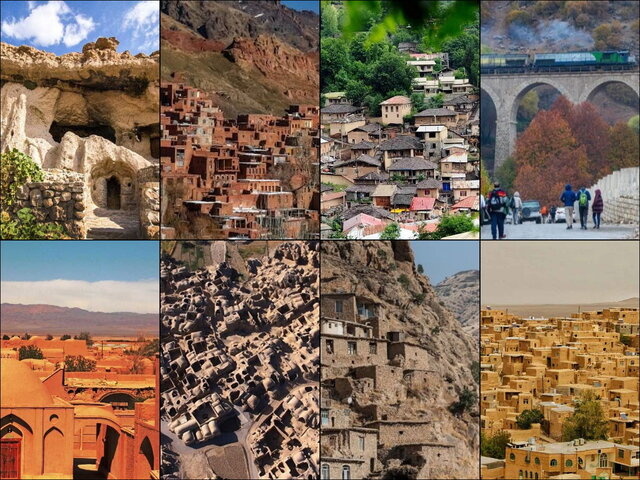
Mirath-Aria: The World Tourism Organization (UNWTO) General Assembly will convene on November 16th in Colombia, where the best tourist villages for 2024 will be determined. Last year, the village of Kandovan in East Azerbaijan was selected as the best tourist village in the world. The villages of Abyaneh in Isfahan Province, Kandolus in Mazandaran Province, Bisheh in Lorestan Province, Meymand in Kerman Province, Fehraj in Yazd Province, Palangan in Kurdistan Province, Esfehak in South Khorasan Province, and Qaleh Bala Village in Semnan Province are on the list of 8 candidate villages for global competition.
Palangan, Kurdistan
Palangan is one of the terraced and ancient villages of Kurdistan Province, which is also called the "Lost Paradise" or the "Masuleh of Kurdistan" due to its natural beauty. Certainly, upon hearing the name Palangan, the first thing that comes to mind is the leopard. Yes, you guessed correctly! Because the name of this village is related to the leopard, and it is said that in the past, leopards lived in the mountains of this region, and for this reason, the local people call it "Palangan," which is more widely known as "Palangan." Of course, "Pal" in Kurdish means support.
In this village, there are no multi-story buildings, as all houses are terraced, and the roof of one house is the courtyard of the house above it. The age of this terraced village dates back hundreds of years, and traces of history can be seen in the remains of the mosque, ancient houses, and the cemetery. The age of Palangan village predates Islam, and its houses have been destroyed and rebuilt several times in different periods. This village was the center of Ardalan governance for over 400 years. The Ardalan Emirate, belonging to Kurdish dynasties, ruled over northwestern Iran, i.e., parts of the Kurdish regions, for over 700 years (approximately from the mid-7th century to the late 13th century AH (1169 to 1867 AD), i.e., until the late Qajar period. The Ardalan rule claimed lineage from Ardashir Babakan, the founder of the Sasanian Empire.
However, some archaeologists believe that the age of this village dates back to the Median period. The examination of historical remains from the castle, fire temple, and several bridges are documents that prove Palangan was inhabited even during the Median period. Also, this village has an ancient cemetery with inscriptions on tombstones in Kufic script. The age of these graves dates back to the 7th century AH. This village is located in Kurdistan Province, 47 kilometers northwest of Kamyaran, in the Tangi-Var valley.
Bisheh, Lorestan
Bisheh village is a village in Lorestan with a historical background dating back about one hundred years to the time of the construction of the southern national railway during the first Pahlavi period. With the establishment of the Bisheh railway station in 1927 AD, the terraced village of Bisheh gradually took shape around the railway with a dense texture and local materials. The village of Bisheh is located in a mountainous area with a steep slope and a dense residential texture on both sides of the railway, arranged in a terraced architecture. The houses in the village are close to each other and built on one floor. The most important materials used in the village houses are mud bricks, stone, and wooden beams, which are used to build houses that, in addition to beauty, act as insulation against heat and cold. Most of these houses currently serve tourists as guesthouses and ecotourism accommodations.
The most important historical attractions of the village are the passage of the national south-to-north railway through the heart of the village, the presence of the railway station and its related structures, as well as the historical railway bridge with a hundred-year-old history. The national railway line of Iran, the most beautiful part of which is in Lorestan and in the Bisheh region, was registered as a UNESCO World Heritage Site in 2019.
The beautiful Bisheh waterfall, with a height of about 50 meters and a crown width of 20 meters, cascades down from the rocks from bubbling springs. This waterfall was registered in the list of national natural heritage of Iran in 2008. The water of the waterfall flows into the Sezar River, which eventually joins the Dez River. The proximity of Bisheh village to the railway station and easy access to it has made this area prosperous in terms of tourism. Its importance is such that it has been introduced in the famous Lonely Planet travel guide.
Abyaneh, Isfahan
Abyaneh is a village in the central district of Natanz County, Isfahan Province, located at the foot of the Karkas Mountains. The local people also call it Viona. "Vio" means willow, and "Viana" means willow grove.
It is said that Abyaneh is one of the highest-lying residential areas in Iran. The combination of desert and mountains in Abyaneh creates a pristine and beautiful landscape that differentiates this village from other villages in Iran. There is no precise and documented history for this village, but the discovery of artifacts related to the Sasanian and Seljuk periods confirms its historical significance. It can be said that there are signs of human settlement in Abyaneh from the Sasanian era and even before. With this in mind, if we count from the Sasanian period, Abyaneh is about 1300 to 1800 years old.
The red architecture of Abyaneh's houses, along with the traditional attire of the local people, attracts 40,000 tourists annually.
The first famous structure in Abyaneh is its fire temple, built on the peak of Karkas Mountain. This fire temple is called Harpakh and is a relic of the Sasanian period in this village. In addition to the famous fire temple, there are three watchtowers in the village that were built to protect the village from thieves and bandits. These castles are named Herdeh, Yousmon, and Pale. Alongside these, Abyaneh's shrines are also very spectacular. There are two holy places in Abyaneh: Imamzadeh Yahya (AS) and Imamzadeh Issa (AS), who are sons of Imam Musa al-Kadhim (AS). Abyaneh has several mosques, among which the Jameh Mosque is the most famous.
The most famous spring in Abyaneh village is the Reisoon spring, which supplies the village's drinking water. Other springs in the village, which are also considered tourist attractions of Abyaneh, include: Kreshk spring, Pale Hamun Herah spring, Taridar spring or qanat, and Hinza spring.
Meymand, Kerman
The village of Meymand is located 38 kilometers northeast of Babak city in Kerman Province. This village is one of the world's rock-dwelling settlements and Iran's nineteenth World Heritage Site registered on the UNESCO World Heritage List. Some believe Meymand means auspiciousness and blessing. Among the very old artifacts of this village are scattered rock-hewn houses, a temple, a castle, and various towers dating back thousands of years.
Pottery discovered in this region proves that the age of these pottery pieces dates back to the Parthian, Sasanian, and Islamic periods. This village belongs to the 2nd and 3rd centuries AD. During the Parthian era, nomadic tribes migrated to different regions in the southern part of Kerman, but those tribes that did not move chose a pleasant climate for settlement in the late Parthian and early Sasanian periods and built houses in the heart of the mountains. In addition to the above theories, many experts estimate the age of this village to be between 8,000 and 12,000 years. The rock carvings in the region, attributed to 12,000 years ago, are one of the pieces of evidence cited by these experts.
The most important characteristic of this ancient village, which is registered as a national heritage site, is the residential use of Meymand's rock-hewn units. Unlike other places where people stack stones to build their homes, in this amazing village, houses are built by removing and carving stones. If you look closely, you will notice that the roof of each house is the courtyard of the house above it, and the concept of alleys or sidewalks is not very significant. In this rock-hewn village, 400 houses are arranged on two to five floors, one above the other, known as "Kicheh." These Kicheh have 2,500 rooms. To enter the Kicheh, one must pass through an open-air corridor carved into the mountain. These Kicheh have short doors, requiring one to bend slightly to enter. From the outside, the Kicheh vary in size but do not exceed ninety square meters in area. Niches are carved into the walls of the rooms, serving as places to keep utensils, bedding, or lamps.
Fehraj, Yazd
This village is located in Yazd Province, central district of Yazd County, southeast of Yazd city, 22 kilometers from the Bafq-Yazd road, and its age dates back to the pre-Islamic era. Some believe that this village is over five thousand years old. In ancient times, Fehraj was the gateway to Isatis and one of the four important and main districts of the old historical city of Yazd, and it was considered one of the important cities of Yazd until the 8th century AH. Ibn Balkhi also mentions its important agricultural status in his descriptions of this city.
The name of Fehraj village, like its history, is related to the pre-Islamic period. This village was initially known as "Farafr," but over time, in the 4th and 5th centuries AH, it was changed to "Pahrah" or "Pahresht," and then to "Fehraj." The village of Fehraj and most of its houses and buildings, like other settlements in the desert province of Yazd, are built with the traditional architecture of Iran's hot and desert regions. Houses are made of mud brick, mud, brick, and iron. The old texture of the village is semi-centralized and linear around the Jameh Mosque located in the heart of Fehraj village, and the modern texture of the village extends around the historical texture.
On the roofs of some of the authentic houses in Fehraj village, you will see windcatchers, which are a sign of Iranian ingenuity for cooling houses during hot days in the desert. Walking through the alleys of this village, you will encounter semi-covered passages called "Sabats." These covered alleys not only double the architectural beauty of the city but also reduce the intensity of the heat by providing shade and relieving the fatigue of passersby.
Esfehak, South Khorasan
The village of Esfehak is located in Tabas and 38 kilometers east of this county. Despite its small size, this village is very famous for its historical texture and its beautiful dry mud and brick construction. 1978 was the harshest year for Tabas, as the most powerful earthquake in Iran's history devastated many villages in Tabas.
This abandoned village has no brick or modern structures. The entire texture of this village is composed of mud and brick houses, built with great artistry. The mud walls and domed roofs have eliminated the oppressive heat of the desert and draw cool breezes into the homes of the village residents. The winding low mud walls also act like a tunnel, circulating cool breezes throughout the village.
The peak of the beauty of these structures is enhanced by the palm trees planted among the houses, making the village's atmosphere and scenery very beautiful and eye-catching. In addition to all the attractions of this village, the Jameh Mosque and the old bathhouse can be mentioned. The reservoir bath and the mosque of this village, built on one floor in a completely traditional style suitable for the desert climate, are still standing.
One of the popular attractions of desert areas is stargazing at their starry nights, and Esfehak village is no exception. Shortly after the village was built after the earthquake, a desert observatory was established in this area to showcase the most beautiful night sky. The observatory consists of three concentric brick walls that welcome tourists and desert trekkers from sunset.
And here's an interesting point! Inside the Jameh Mosque of this village, there are various corners or columns. Imagine you are standing in one of the corners of the mosque, and your friend is standing in the farthest corner from you. If they speak in the quietest possible manner, you will hear their voice clearly. Therefore, the interesting architecture of Esfehak's Jameh Mosque is likened to a walkie-talkie and telephone.
Qaleh Bala, Semnan
The village of Qaleh Bala is 24 kilometers from the village of Biyarjomand and is located 140 kilometers south of Shahroud. It is said that in the past, a group from the Ismaili sect under the command of Hassan Sabbah took refuge in a cave in the southern mountains of this village called Malhedin, which is now known among the local people as Malhedo. Due to its location in the foothills of Semnan, Qaleh Bala has a beautiful terraced architecture, and the roofs of the lower houses form the courtyards of the houses above them. Additionally, the cream-colored texture of the houses, due to the use of straw and mud, gives Qaleh Bala a unique and uniform appearance, blending with its surrounding desert. The higher elevation of Qaleh Bala compared to its neighboring villages has earned it the nickname "Green Jewel of Turan."
Among the tourist attractions of Qaleh Bala is the Turan National Park, known as the gateway to the Turan Wildlife, and can be referred to as the "Africa of Iran." With an area of nearly 1,470,000 hectares, it hosts thousands of animal species, including birds, mammals, reptiles, and amphibians. This region, after Serengeti National Park in Tanzania, is considered the largest habitat for animals. Among the most famous animals in this region are the Iranian gazelle, Iranian zebra, Asiatic cheetah, caracal, Pallas's cat, sand cat, and jungle cat. Also, near Qaleh Bala are the Ali Angar and Delbar plains, which are part of the Khartun protected area.
Bubbling springs emerge from the desert lands of Qaleh Bala, including Houzdeh, Anabu, and Delbar, which create a unique spectacle alongside the desert landscape. Among the most beautiful manifestations of this village are the special songs and melodies of the region, sung during wedding ceremonies and local festivals. Carpet weaving, needlework, and "tan-bafi" (a type of weaving) are examples of the local crafts of Qaleh Bala. Sericulture and silk thread production are among the traditional industries of Qaleh Bala.
Kandolus, Mazandaran
Kandolus is a very beautiful and mountainous village in Mazandaran Province. This village is located at the foot of the Alborz mountain range, and one can easily find traces of pre-Christian civilization, pre-Islamic Iranian civilization, and post-Islamic Iranian civilization. Another part of the historical narrative of this village dates back to the Qajar period, when in 1913 AD, Naser al-Din Shah Qajar spent a few days in a place near the village called "Tangeh Mikhaz" and spoke of his accommodation in his travelogue. Interestingly, Kamal al-Molk was also with him, and this famous painter depicted the village of Kandolus in a spectacular and mesmerizing painting, which is now housed in the Sahebgharanieh Palace in Tehran.
The village of Kandolus consists of two valuable and ordinary textures, and new constructions are prohibited in the valuable texture. The tourist part of Kandolus has paved pathways and houses with straw-mud facades, traditional windows, and "lati" roofs. The main occupation of the people in this region is agriculture and animal husbandry, although some individuals also specialize in the production and cultivation of medicinal plants.
The Kandolus Museum is the first rural museum in the world and one of the richest ethnographic museums in the Middle East. The museum is built on two floors and focuses on local and regional artifacts. From very old handwritten books to various ancient tools, old objects, and local clothing, everything can be found there.
Additionally, the village has an old reservoir bath attributed to the Qajar period. Five kilometers from Kandolus village, there is a 10-meter waterfall surrounded by a forest. At this waterfall, water emerges from the top of the mountain cliff and cascades down in fine droplets like rain, creating a dreamlike scene.