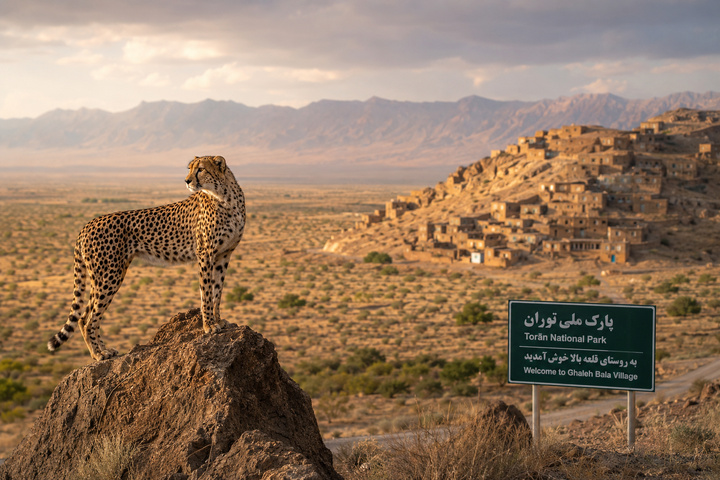
Qaleh Bala: A Gateway to Protecting the Asiatic Cheetah — From the Birth of Pirouz to Faraz’s Hope for Survival in the Heart of Touran
In Touran, where the tracks of the Asiatic cheetah can still be found across the plains of eastern Semnan, Pirouz was born—a cheetah cub who became a symbol of hope for Iranians determined to save one of the country’s most endangered wildlife species.
Pirouz is gone, but the story of hope continues in Touran: in the cheetahs’ natural habitat, in the tireless efforts of rangers, and in Qaleh Bala, a village where wildlife still has a reason for hope.
Many Iranians remember Pirouz, the ten-month-old cheetah cub who, for several months, became one of the most recognizable figures across Iran’s media and social networks. He was born on May 1, 2022, in Touran at the Asiatic Cheetah Breeding Center, following the mating of Iran and Firooz.
Pirouz was the only survivor of three cubs born during that breeding attempt. He died on February 28, 2023, from complications related to kidney failure. His death plunged many Iranians into collective mourning, with countless people sharing his photographs and personal tributes online to commemorate his life.
Perhaps Pirouz’s death served as a wake-up call, prompting a more urgent question: Where will the future of the Asiatic cheetah in Iran ultimately be secured—in captivity or in the wild?
Today, the answer is more closely tied to Touran than ever. This vast landscape is one of the most important remaining strongholds of the Asiatic cheetah anywhere in the world.
Touran: The Last Stronghold of Hope for Iran’s Cheetah
Two Decades on the Tentative World Heritage List
The Touran Biosphere Reserve is one of Iran’s most important natural areas. It encompasses vast plains, mountain ranges, and dry, sandy, and saline habitats supporting a remarkable diversity of plant and animal species.
The area has been part of UNESCO’s Man and the Biosphere Programme since 1977 and was added to Iran’s Tentative List of World Heritage Sites in 2007. UNESCO describes Touran as Iran’s largest protected-area complex, with the Asiatic cheetah, Persian onager, and sand cat among its emblematic species.
Touran’s importance to the Asiatic cheetah becomes even clearer when we consider that virtually the entire known population of this subspecies is now concentrated in Iran. The future of the cheetah in the country is therefore closely tied to the quality of protection provided to habitats such as Touran.
Yet the threats today extend far beyond hunting or direct habitat destruction. Declining prey populations, drought, climate change, human–wildlife conflict, and particularly roads crossing critical habitats all pose serious risks to the cheetah’s survival.
This summer, the presence of cheetah Helia and her three cubs near the heavily trafficked Abbasabad–Mayami road raised renewed concerns about potential road mortality, leading to intensified monitoring and patrols along the route.
At the same time, the appearance of Faraz, a male cheetah in Touran National Park, in monitoring footage offered a reminder that life continues to endure in this fragile ecosystem.
Six Cheetahs in Captivity: A Hope Yet to Be Fulfilled
Recent monitoring has placed Iran’s cheetah population at 27 individuals. For a species that once ranged across much of the Asian continent, this number may offer little comfort. Yet it also represents evidence of survival and of an ongoing, unequal struggle to preserve the species—a reminder that protecting natural habitats can still make a difference.
In recent years, Iran’s Department of Environment has pursued captive and semi-captive breeding alongside the protection of natural habitats, seeking to prevent the loss of the Asiatic cheetah’s remaining genetic diversity.
According to the latest statements by the Director General of Semnan Province’s Department of Environment in 2026, six Asiatic cheetahs—one male and five females—are being kept at the Touran Research and Breeding Center.
Firooz is the center’s only male cheetah and currently lacks the reproductive capacity required for breeding, presenting a major challenge to the captive-breeding program.
This situation highlights an important reality: even when suitable facilities, space, and female cheetahs are available, the breeding chain cannot be completed without a fertile male.
At the same center, Abrisham, Azar, and Touran, which had not yet reached reproductive age in previous years, have now reached maturity, making their potential participation in the breeding program possible. Yet the absence of a fertile male remains the central obstacle.
The situation demonstrates that although captive breeding can serve as an important supporting conservation tool, it cannot, on its own, provide the ultimate answer to the cheetah’s survival crisis.
The Corridor of Love: Between Hope and Uncertainty
At the Touran breeding center, an area has been designated for introducing male and female cheetahs to one another. Locally known as the “Corridor of Love,” it carries a poetic name for a matter that is entirely scientific—and critically important.
Behind the romantic expression lies a serious question: Can bringing a small number of cheetahs together in captivity compensate for part of the species’ population crisis?
The experience of recent years offers no simple answer.
On one hand, Pirouz’s birth demonstrated that reproduction under controlled conditions is possible. On the other, the deaths of three cubs and the difficulties encountered in sustaining the breeding process showed that a successful birth is a long way from a successful conservation program.
Today, even with six cheetahs at the center, the shortage of a fertile male remains unresolved.
The “Corridor of Love,” therefore, is not the end of the story. It is one stage in a complicated and challenging conservation effort.
The real question is not simply whether cheetahs can mate. It is whether cubs can be born healthy, survive, develop natural behaviors, and ultimately—if the conditions allow—return to the wild.
This is where the distinction between breeding and species recovery becomes clear.
The Cheetah’s Future Belongs in the Wild
Perhaps this is the most important point in the entire story.
If the ultimate goal is to save the Asiatic cheetah, its final destination cannot be a cage.
Even if captive breeding succeeds, its true value will only be realized when healthy natural habitats remain available for cheetahs to return to and live in.
This is what makes Touran so important.
Captive breeding can serve as a safety net, but natural habitat is home.
Protecting Touran’s plains, maintaining adequate prey populations, reducing human–wildlife conflict, managing livestock presence, making roads safer, and continuously monitoring wild cheetahs have therefore become more important than ever.
In this context, road-monitoring programs along the Abbasabad–Mayami corridor have continued in 2026 with the participation of several provinces and environmental volunteers. Such efforts demonstrate that cheetah conservation cannot be confined to protected areas alone; it requires cooperation among government agencies, conservation organizations, and local communities.
The People of Qaleh Bala: Champions of Conservation
Against this backdrop, Qaleh Bala represents far more than an ordinary tourism village.
Situated next to one of the most important habitats of the Asiatic cheetah, Qaleh Bala has the potential to become a point of connection between three essential elements: nature, local community, and tourism.
Over the years, this idea has increasingly taken practical form through initiatives aimed at educating and engaging local residents. The people of Qaleh Bala can be regarded as important local champions of environmental conservation in Iran.
This is where the concept of sustainable tourism becomes meaningful.
If tourism is reduced simply to increasing visitor numbers, overnight stays, and the sale of services, it can itself become a source of additional pressure on the environment.
But when tourism is combined with education, conservation, and meaningful local participation, it can become part of the solution.
Wildlife tourism in Qaleh Bala does not have to promise visitors a glimpse of a cheetah. Instead, it can offer something more valuable: an opportunity to understand the cheetah.
Visitors can stay in the village, experience local culture and everyday life, taste traditional food, work with local guides, and learn about Touran, the cheetah’s habitat, the threats it faces, and the role each visitor can play in protecting it.
Getting close to a cheetah may make for an attractive photograph. Keeping visitors at a respectful distance, however, is far more valuable for preserving the animal’s peace and natural behavior.
The experience of Touran demonstrates that conservation cannot be sustainable without local participation.
In recent years, the role of local communities in cheetah conservation has repeatedly been emphasized. Even observations and photographs of individual cheetahs recorded by local residents have shown that communities living around protected habitats can become an important part of wildlife monitoring—not merely neighbors of wildlife.
Ultimately, if tourism generates income and part of that income reaches the local community, wildlife can shift from being perceived as a constraint to being recognized as an asset.
That is the point at which the village economy and nature conservation can reinforce one another.
Qaleh Bala and the Dream of Global Recognition
The coexistence of a human community with one of Iran’s most valuable wildlife ecosystems is also one of the defining elements of Qaleh Bala’s candidacy for inclusion in the Best Tourism Villages initiative.
It is a characteristic that distinguishes Qaleh Bala from many other rural tourism destinations.
Here, cultural heritage and natural heritage do not follow separate paths.
The village’s houses, way of life, food, handicrafts, and local traditions form one side of the story. Touran, the Asiatic cheetah, the Persian onager, and other wildlife species form the other.
Between them stands humanity—capable of being both a threat and a solution.
From Pirouz to Faraz: The Story Is Not Over
Pirouz is gone.
Iran and Firooz have also passed beyond those hopeful days, while the captive-breeding program continues to face significant challenges.
But the story of the cheetah in Touran is not over.
Faraz still appears in wildlife monitoring footage.
Helia and her cubs are still living in the wild.
Abrisham, Azar, and Touran have reached maturity.
And elsewhere, rangers continue monitoring the vast plains of Touran and the dangerous roads surrounding them, day and night.
These are the things that keep hope alive.
When it comes to the cheetah, hope is a responsibility.
Hope means that habitat still exists and that cheetahs can still be seen in the wild.
Hope means that roads can still be made safer, natural prey can still be protected, and local communities can still be brought into the effort to safeguard nature.
Qaleh Bala: Where Wildlife Still Has Hope
Perhaps the true value of Qaleh Bala becomes visible precisely here.
Qaleh Bala does not have to show the world merely another beautiful image of Iran.
It can tell a deeper story: the story of people living alongside one of the last remaining habitats of the Asiatic cheetah, and of a community using responsible tourism to help shape the future of that habitat.
Touran is one of the last strongholds of hope for a precious part of Iran’s natural heritage.
Qaleh Bala can be a human gateway to understanding Touran.
Years from now, when the fate of the Asiatic cheetah in Iran is judged, the question may not simply be how many cheetahs were born in captivity.
The greater question may be whether we managed to keep the natural world safe enough for the cheetah to continue living in it.
If the answer one day is yes, an important part of that answer may be found in a village like Qaleh Bala—a place where, when humanity makes the right choices, people can become not competitors with nature, but its guardians.