Revisiting the Bond Between Mourning and Authenticity: The Ashura Votive Tradition in Qaleh Bala
The Ashura rituals in Qaleh Bala Village, Shahrud County, have evolved beyond a religious ceremony into a powerful expression of social solidarity and cultural continuity. Traditional rituals, extending from the village mosque to the cemetery, together with the widespread distribution of votive offerings by local residents, reveal a deep connection between religious beliefs and the indigenous social structures of the community.
Amid the vast, sun-scorched silence of the desert, where the winds whisper ancient stories across the dunes, Qaleh Bala stands in Shahrud County—a village where time seems to move at a gentler pace. Yet on one of the most profound days of the year, Ashura, the desert’s silence gives way to the sounds of mourning and the inviting aromas of votive offerings.
In Qaleh Bala, Ashura is far more than a religious date on the calendar. It is a living cultural experience in which the boundaries between earth and sky, the living and the dead, and faith and local culture seem to dissolve in a deeply moving display of communal devotion. This account explores an experience in which Husayni mourning is intertwined with deeply rooted local traditions, creating a powerful expression of unity and intergenerational continuity.
A Village Transformed by Ashura
At dawn on Ashura, the rhythm of life in Qaleh Bala changes. The everyday atmosphere of the village gives way to one of solemnity and reflection. The ceremonies begin with the gathering of mourning groups for sineh-zani (ritual chest-beating) and zanjir-zani (ritual self-flagellation with chains) at the village’s central mosque. The mosque, itself a symbol of spiritual refuge for the community, becomes a meeting place for generations from the earliest hours of the day.
Within the orderly processions, a striking harmony between generations can be seen. Elderly men, their deeply lined faces bearing the marks of years spent enduring the hardships of the desert, stand alongside young people who enthusiastically shoulder the responsibility of preserving these traditions. Children in black clothing stand beside their fathers, watching with curious eyes. They are not merely witnessing a ceremony; they are learning a sense of identity.
Reciters of elegies for the Prophet Muhammad’s family perform mourning songs rooted in the region’s oral traditions, creating an atmosphere in which tears become more than an emotional response—they become an expression of spiritual remembrance and devotion.
The village elders and respected community leaders take their places at the front of the procession. As the oral custodians of the village’s history, they carry black flags and symbols of mourning, seemingly leading a procession whose destination is not simply a physical place, but Karbala as remembered in the hearts and minds of the mourners.
The procession moves from the mosque toward the cemetery. On ordinary days, this route is simply a passage through the village; on Ashura, it takes on a deeper spiritual meaning. Each step is accompanied by prayers, elegies, and a measured solemnity that reflects the connection between personal faith and collective tradition.
At the Cemetery: Connecting the Living and the Departed
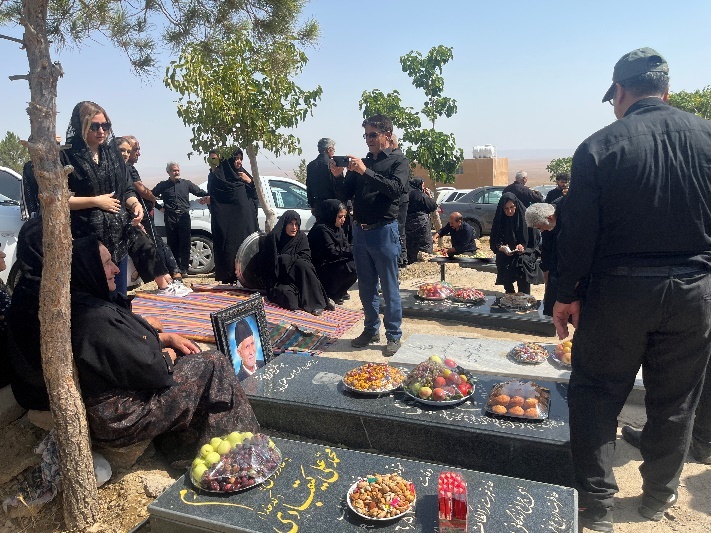
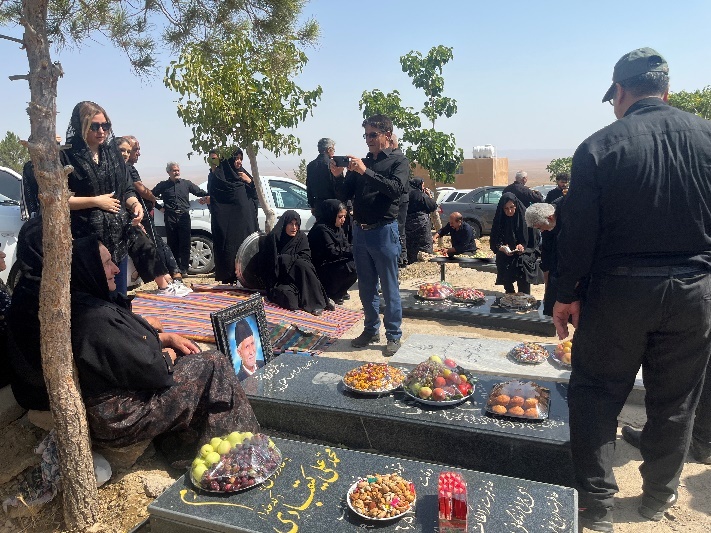
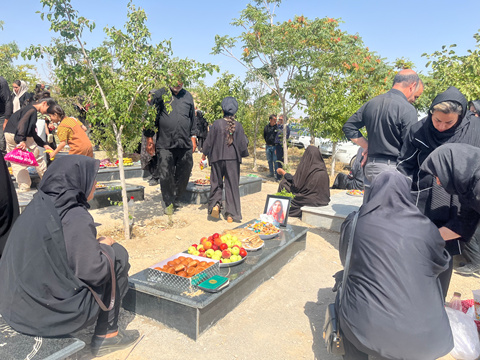
When the mourners reach the cemetery, the ceremony reaches one of its most poignant moments. On Ashura, the cemetery of Qaleh Bala is transformed from a quiet place of remembrance into a space of profound connection between the living and those who have passed away.
As mourners gather at the graves of their loved ones, they connect the collective memory of Karbala with their own experiences of loss and remembrance. The suffering of Imam Hussein and the martyrs of Karbala becomes intertwined with personal and family memories of grief.
In this moment, death is no longer perceived simply as an ending, but as an opportunity to reconnect with one’s roots. Tears shed at the graves are offered in remembrance of the martyrs of Karbala, while also serving as a gesture of respect toward the deceased members of the village, who seem to return symbolically to the community on this day.
This part of the ceremony demonstrates how a religious ritual can serve as a bridge connecting generations, families, memory, and community within a small rural society.
Votive Offerings: Sharing in Faith and Community
Following the spiritual and mourning rituals, another important dimension of Ashura comes to the fore: nazr, or votive offerings. If the first part of the ceremony expresses the spiritual dimension of the tradition, the second gives that devotion a tangible and communal form.
The women of the village, who play a central role in preserving household traditions and community practices in desert settlements, begin preparing for the ceremony days in advance. Their kitchens become places of collective service and devotion.
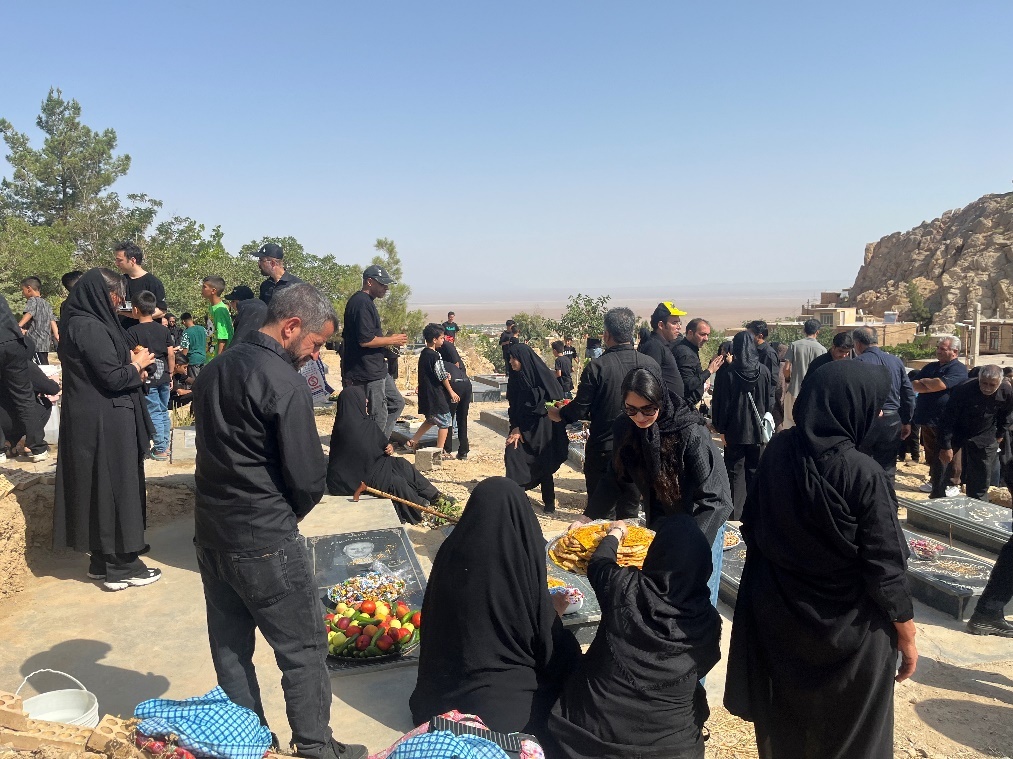
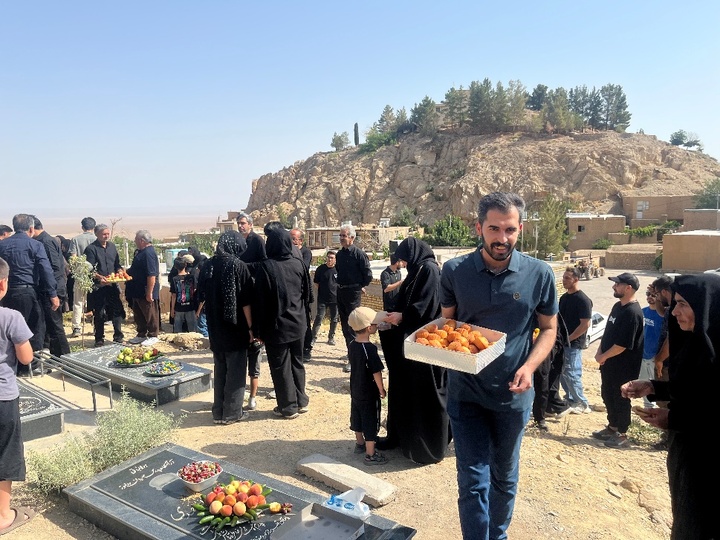
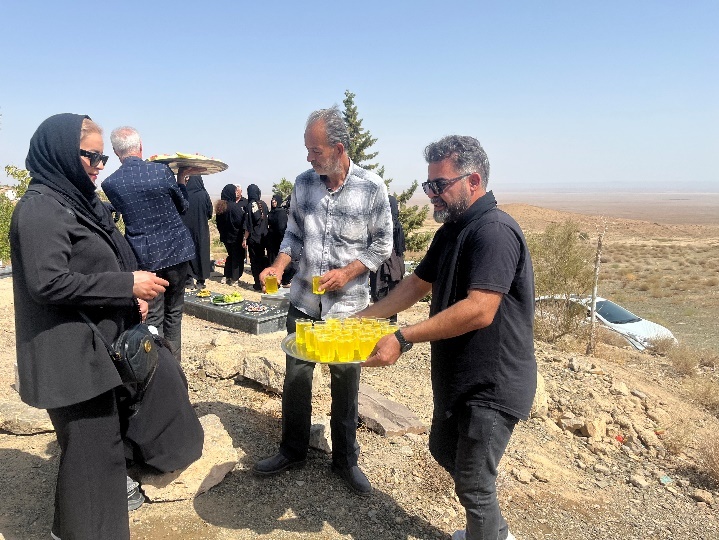
The cloths and communal spreads laid out near the graves are far more than arrangements of food; they represent generosity, remembrance, and the sharing of blessings. Fresh bread, local sweets, dates, seasonal fruit, and refreshing drinks are prepared with great care.
Every portion distributed during the ceremony is offered with the intention of charity, remembrance, and seeking peace for the souls of the departed. From a social perspective, these votive offerings also function as a form of shared generosity: distinctions of wealth and social standing temporarily fade as people gather around the same tables and partake with a common intention.
The tradition strengthens social networks and reinforces bonds among families, particularly at a moment when the community collectively confronts the universal experience of mortality and remembrance.
A Community-Built Tradition
What distinguishes Ashura in Qaleh Bala from an ordinary religious ceremony is its deeply participatory nature. It is a community-led tradition in which residents themselves take responsibility for almost every aspect of the event.
From preparing ingredients and organizing mourning groups to welcoming guests, distributing food, and maintaining the routes used by the processions, the ceremony depends on collective effort.
This participation serves several important functions:
1. Preserving Identity
At a time when globalization can place local traditions under increasing pressure, the ceremony acts as a safeguard against cultural forgetting. Young people observe the dedication and organization of older generations and, through their own participation, carry these cultural values forward.
2. Strengthening Social Cohesion
The cooperation of women and men in preparing votive offerings and organizing the ceremonies strengthens the village’s social capital. This spirit of cooperation extends beyond Ashura and can also be seen in everyday activities, from agricultural cooperation to addressing shared community concerns.
3. Sustaining Collective Memory
On this day, the village becomes a kind of living museum. Every step along the route from the mosque to the cemetery evokes layers of history, religion, and local culture, preserved and retold through ritual and communal participation.
A Living Expression of Humanity
Ashura in Qaleh Bala is more than a religious ritual; it is a profound expression of humanity. It demonstrates how, from the experience of grief and remembrance embodied by Ashura, and within the geographic limitations of a desert environment, a remarkable culture of empathy, solidarity, and communal belonging can emerge.
Here, religion, culture, and humanity are deeply intertwined. Faith gives meaning to mourning; culture gives it form; and humanity becomes the spirit carried through every tear, every act of generosity, and every shared meal.
By preserving this tradition, Qaleh Bala reminds us that history and the future acquire meaning when their roots remain firmly grounded in authenticity and faith. This living tradition not only nourishes the spirit of the community but also offers a powerful reminder that even in the smallest villages, some of the most profound expressions of human connection can be found.
Report by Fatemeh Gholipour, Anthropological Researcher, Shahrud County