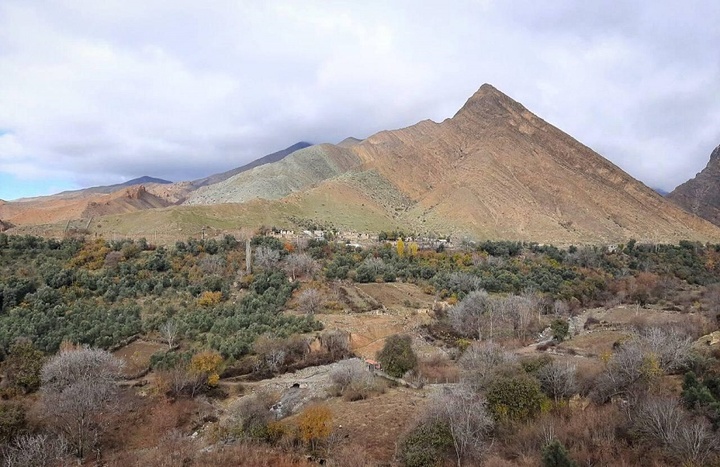
Hazar Rud Village in Tarom County is Among the Attractions of Zanjan Province
Hazar Rud village is one of the important, large, and populous villages of Tarom County, affiliated with Zanjan Province. This village has a long and ancient history. ... whose ruins are currently standing under the names "Qaleh Pash" and "Qaleh Bon," Qaleh Pash meaning the upper castle and Qaleh Bon meaning the lower castle...
Mirath Arya: Hazar Rud is a land whose climate many compare to the Mediterranean. Sky-high trees, peace nestled behind flowing springs, a land of authentic Azerbaijani music, and a land that must be visited to be understood.
Hazar Rud is a village located five kilometers west of Abbar, the center of Tarom County. It overlooks the Qizil Uzun River to the south. The northern part of Hazar Rud overlooks the mountains and summer pastures of this village, where Asman Kuh or Masuleh Dagh mountains are located. An old, mountainous pedestrian path connects it to Masuleh. The distance from Hazar Rud village to Zanjan is about 120 kilometers, and to the city of Manjil is about 60 kilometers. Hazar Rud village is one of the important, large, and populous villages of Tarom County, affiliated with Zanjan Province. The climate of this village, like other areas in Tarom County, is Mediterranean and temperate, and for this reason, it has the potential and capability to grow any type of crop.
A river with clear and significant water originates from the northern mountains of this village. After irrigating the olive groves, walnut trees, pomegranate trees, and agricultural lands of this village, it flows into the great Qizil Uzun River after a ten-kilometer course.
The history of Hazar Rud, as mentioned in the writings of Etemad al-Saltaneh in the year 1296 AH (1878-1879 CE), is as follows:
"The old system is the best of the villages behind the mountains. It has eighty households of peasants and fifty households of Sayyids. The style of their buildings is like Gilan. A river flows in the middle of the settlement, and there are thirty neighborhoods that are far from each other. They cultivate fifty pairs of land. There is a farm called Behren Abad, where some of the two households of this village reside. The produce there is irrigated by the river. They plant a lot of cotton and vegetables. They have many gardens and pay 340,500 Tomans in state taxes. Its climate is warm."
Hazar Rud is a foothill village, and its residential houses are scattered and arranged in a V-shape over time. The 2812-meter peak of Asman Kuh is located in the northern part of the beautiful Hazar Rud region and in the southeastern part of the historic city of Masuleh. Asman Kuh has an almost conical shape and is mostly covered with snow and ice, and it has many cold mineral springs. The peak of Asman Kuh, north of Hazar Rud in Tarom County, is connected to the Baklor Mountains via the eastern ridge, to the Laseh Sar peak via the western ridge, and finally to the Shah Moallem and Tur Shum peaks via the Andareh pass. These heights are continuations of the Talesh Mountains, extending to the Safid Rud valley and featuring numerous hills and valleys. They are divided into two regions: one is the high region located between Gilan, Tarom, and Khalkhal, which was formerly a forest; the other is the coastal plain with fertile alluvial soils, forming the agricultural lands of Gilan.
The language of the villagers is Azerbaijani Turkish, although in the past, some villagers spoke the Tati language. Hazar Rud is one of the producers of garlic, olives, pomegranates, persimmons, and other products in the region.
Historical Sites and Buildings
In ancient times, two ancient castles existed above and below a tall natural cliff in a place called "Golf." Their ruins, known as "Qaleh Pash" and "Qaleh Bon," still stand today. Qaleh Pash means the upper castle, and Qaleh Bon means the lower castle.
1- Qaleh Pash:
It was built at the highest point in a place called "Golf," atop a tall cliff. Historically, what illegal excavators say about it relates to the "Median" period, after which they fled to Gilan. The remains of a large pool and cistern, built of stone and mortar, are now evident, having been unearthed from beneath the castle ruins. Several large and small caves exist around this castle, one of which extends for hundreds of meters. Discovering the full dimensions of this cave requires a large and well-equipped speleological team and expedition.
Experienced local individuals say that small and large streams of water flow on the floor of this cave, and limestone columns hang from the ceiling in spectacular shapes, known in geology as stalactites and stalagmites. The only observed living creature is bats. It should be noted that these individuals have entered this cave with limited equipment in search of treasure and artifacts.
2- "Gonbeh Tabar" Castle:
These ancient residential ruins are located one kilometer below the sites of Qaleh Pash and Qaleh Bon. A few years ago, the remains of several old buildings constructed in circular and diamond shapes were present, but unfortunately, they have been destroyed due to neglect.
3- Hayat Mahalleh:
This old site was the center of governance for an individual named Mehdi Khan, and his brother, Biuk Khan, ruled Abbar.
4- Old Residential Neighborhood Called Zibashahr or Qaleh Gheybollah:
Qaleh Gheybollah was completely intact until a few years ago and was a fascinating sight. From the writings and carvings inside the structures, it appears that a completely Muslim group lived there, belonging to the 7th or 8th century AH (13th or 14th century CE). Several caves are located above this castle on the mountainside, which served as shelters for their livestock. Other historical and ancient buildings in this village, which we will only mention by name, include: "Qez Qaleh," "Qaleh Souzan," "Old Tower," "Nesa Kuh," and others.
In any case, the historical and natural attractions of Hazar Rud are such that they attract every type of traveler with every taste.
Hazar Rud is among the villages that have remained pristine and untouched despite the advancement of technology and industry in the region over many years. In some houses, despite the presence of lavash and barbari bakeries, the baking of local bread is still done in some homes.