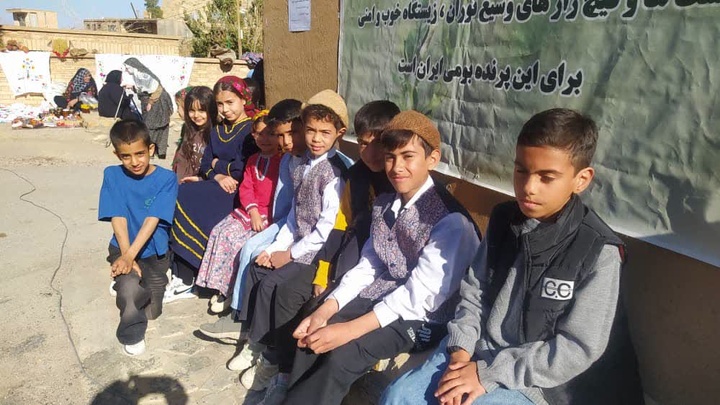
Children of Qaleh Bala Village; Little Ambassadors of Culture and Hope on the Path to Sustainable Tourism Development
Qaleh Bala village, the jewel of the desert and one of the prominent villages of Semnan province, today witnesses children who, with love and affection for their homeland, have taken on the heavy burden of introducing the village's culture and identity. These children not only... think. In Qaleh Bala village, they do not just play and study, but they are storytellers of their homeland's culture, rituals, and identity... and the participation of the local community. In this regard, what distinguishes Qaleh Bala from many rural destinations is the prominent role of children...
Mirath-Aria: In the heart of Semnan's desert, where nature's silence blends with ancient tales, children grow up thinking beyond their years. In Qaleh Bala village, they do not just play and study; they have become storytellers of their homeland's culture, rituals, and identity; little ambassadors who, with their simple childlike language, paint a sustainable future for the village's tourism.
In recent years, the concept of sustainable tourism has received more attention than ever before; an approach that links economic development with the preservation of indigenous culture, the environment, and the participation of the local community. Among these, what distinguishes Qaleh Bala from many rural destinations is the prominent role of children on this path. Children who, with love for their homeland, consciously or unconsciously, have taken on the burden of introducing the village and have become an important link in the chain of sustainable development.
Qaleh Bala is a village that at first glance captivates any passerby with its indigenous architecture, desert landscapes, and pleasant silence. However, what makes the experience of being in this village memorable is the human connection and sincerity that springs from the local community. At the heart of this connection are the children; children who, with their smiles, curiosity, and zest for life, create the first impression of the village in the minds of tourists.
These children are not merely spectators of the village's transformations. With the support of their families, especially their mothers, they actively participate in cultural activities. The bond between generations is still alive in Qaleh Bala; grandparents narrate ancient stories, myths, and rituals, and children listen attentively and retell them in their own words. This oral transmission of culture has created a strong foundation for local identity and has familiarized children with the values of their homeland from a young age.
For this generation, understanding indigenous culture is not limited to books. The children of Qaleh Bala have learned that tourism is not just about the arrival of visitors; it is a collection of experiences: from local melodies and traditional games to handicrafts, local cuisine, and community rituals. They know that each of these elements can be a bridge between the village and the outside world. Therefore, alongside school, they also learn cultural skills; skills that can later become the village's social capital.
Tangible examples of this participation can be seen in the children's cultural and artistic activities. Staging plays about books and reading, establishing the village's children's library, and recreating rituals such as "Naneh Sarma" and the Yalda Night ceremony are just some of their efforts to keep local culture alive. These programs have not only enriched the village's culture but have also boosted the children's self-confidence and turned them into active community participants.
The interaction of children with tourists also has a special dimension. Whenever traveling families arrive in the village, the children greet them with their simple and sincere language, show them the paths, tell a short story about the village, or proudly talk about local ceremonies and cuisine. This direct interaction creates a different experience for tourists; an experience that cannot be found in any brochure or website. It is this human encounter that transforms Qaleh Bala from a mere sightseeing destination into an "experiential" place.
In modern tourism literature, "child tourism" is recognized as an emerging branch; an approach that highlights children's participation in introducing local attractions and culture. In Qaleh Bala, this model has taken shape naturally and spontaneously. Children are the little narrators of history and rituals, and this role has significant social impacts: strengthening cooperation, increasing cultural awareness, developing communication skills, and fostering a sense of belonging to the place.
From the perspective of sustainable development, this early participation is of great importance. The children who play a role in cultural and tourism activities today will be the managers, guides, and preservers of the village's heritage tomorrow. They learn that development should not come at the cost of forgetting identity or destroying nature. Such a perspective is a long-term asset for Qaleh Bala; an asset that cannot be replaced by any development budget.
The role of families in this path is undeniable. Parental support, providing space for children's participation in cultural programs, and encouraging them to learn traditions have created a safe environment for the growth of these little ambassadors. In fact, sustainable tourism in Qaleh Bala has not originated from large projects, but from homes and family relationships.
Of course, this path is not without challenges. Maintaining children's motivation, balancing education with cultural activities, and providing adequate educational facilities require continuous planning and support. If local institutions and tourism authorities can accompany this spontaneous movement with training, soft infrastructure, and support programs, Qaleh Bala can become a national model for children's participation in tourism development.
The experience of this village shows that sustainable tourism does not necessarily develop from top to bottom. Sometimes, a child's smile, a simple play, or a short narration from the past is more impactful than any advertising campaign. Through their active presence, the children of Qaleh Bala remind us that true development originates from the community and is shaped by the participation of different generations.
Ultimately, what is happening in Qaleh Bala today goes beyond introducing a village. Here, an informal school has been formed for learning empathy, respect for culture, and social responsibility. The children who guide tourists today may become the guardians of heritage and architects of the village's future tomorrow. With love for their homeland, they are the little ambassadors of culture and hope; ambassadors who show that sustainable tourism is not a slogan, but a human path that begins in childhood and leads to a bright future.
Report by Fatemeh Gholipour, Ethnology Researcher of Shahroud County